Above The Surface
- shriyadwivedi186
- Jun 15
- 4 min read
One of the largest and worst oil spills in history was the Deepwater Horizon oil spill. In 2010, a Deepwater Horizon oil rig had sunk in the Gulf of Mexico because a bubble of methane gas escaped from the well and shot up to a pipe, causing an explosion. This explosion released an extremely dangerous amount of oil and gas. By the time officials were able to control the oil rig and cap the well, the rig was estimated to have lost around 3.19 million barrels of oil and 11 human lives to the Gulf.
Although according to International Tanker Owner Pollution Federation, "Spills in excess of 7 tonnes have reduced by over 90% since the 1970s," there has been little change in the frequency of spills over the past decade.

What's the science behind cleaning toxic spill management and what do we still have to fear despite the declining numbers?
Contain, Control, and Clean Up
Contain:
As soon as oil spills into the ocean, its toxins and chemicals immediately affect the regional wildlife and are highly likely to have long-term influence on the marine ecosystem. Therefore, the first step that must be taken would be directed to containing the oil spill in order to more easily control the amount of oil in the region it was spilled.
The most popular method used first is implementing booms. Booms essentially are physical barriers that are placed on the water's surface in the area the oil was spilled

Booms have a freeboard (or above-water) section that blocks oil floating the surface, an under-the-surface skirt that reduces underflow of the oil, and a chain that keeps the boundary stabilized in the same relative area. This containment slows down the rate at which oil can spread across the body of water through currents and wind, which causes the slick to thicken and pool, making clean up more efficient.
Therefore booms simply manage oil movement, not oil's transformation and removal.
Control:

Once our oil spill is contained to our best ability, we need to make the oil spill easier to clean up. One method is chemical dispersion. Chemical dispersants are surfactant mixtures (mixtures containing chemical compounds that lower the surface tension between the oil and the water) that are sprayed by a ship or aircraft onto the oil slick floating above the water's surface.
Then, oncoming ocean waves will be able to generate enough energy to break down the slick into tiny oil droplets (usually as tiny as hundreds to thousands of micrometers) which will begin to now float below the water's surface where many natural oil-degrading organisms are present (usually contained in seaweed or marine sediments). This process will eventually breakdown the hydrocarbon bonds within the oil, degrading the very backbone of crude oils.
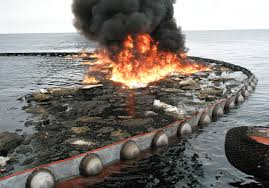
Another method is in situ burning, which literally translates to "burning in place". Like the name suggests, in situ burning occurs when officials burn the oil slick at the exact site or very near to the site that the spill occurred. Officials will place fire-resistant booms around fresh, thick oil slick and then ignite the slick, combusting hydrocarbons in the air and leaving behind oil in a solid form that almost resembles tar.
Clean Up
After simplifying the collection of oil, officials now have to mechanically remove the oil from the water through the process of skimming. Boats will use devices such as oleophilic drums or belts. Since oil has a lighter density than water and automatically floats to water's surface, it is non-polar (in contrast to water which is polar), so it will adhere to other non-polar substances such as oleophilic compounds (like attracts like). This similarity in surface energies allows for vessels to collect the floating oil from the water.

My Take
Although the frequency of oil spills has stayed the same in the past decade, the regular amount of contamination in our oceans polluted our oceans and marine habitat in permanent ways. Therefore, not only should we strive to reduce the amount of spills, but we should also improve the method and procedures towards cleaning up those toxic spills. In fact, as of 2020, only about 2-6% of oil was actually recovered from 30 offshore spills observed.
I believe that our mechanical processes of removing the oil should be more re-usable. Separating the oil from water is one task, but ensuring that oil is cleaned up across the water is an entirely separate goal. Oleophilic drums and belts scrape the oil from the surface of the sea, but in order to ensure that oil is cleaned up more efficiently in deeper layers, we could create a stronger "scraper" that runs continuously within the booms, strengthing the absorbance of the oil into a mechanical and chemical product, re-using our "scraper" and intaking greater amount of oil.
After the Deepwater Horizon oil spill, it's clear that we need to pay more attention to how we are cleaning up our seas. Although it's true that oil spills are very rare, the amount of damage just one can inflict is deeper than we might realize, impacting generations for marine ecosystems, which directly impact our own lives. U.S. oil supply has been increasing each year, and as long as there is oil production, spills will occur regardless of if the risks are reduced. Our oil dependence is clear to all of us in this rapidly advancing and mechanical age, but our ocean dependence is far greater, impacting the food we eat to the heat we feel in our breezes. Therefore, we must actively seek out solutions to preserve and protect the resources we do have.
Sources:


Comments